


Over the past five years, logistics and supply chain organisations have accelerated technology investment at an unprecedented rate.
• 87% have sustained or increased digital investment since 2020
• 93% plan further increases over the next three years
Warehouse automation alone is growing at roughly 15% annually and is projected to exceed $50 billion by 2030. And yet 92% of supply chain leaders acknowledge their technology investments have not fully delivered expected results.
That statistic should make you pause. Because it reveals something uncomfortable: The industry is not struggling to invest. It is struggling to convert investment into compounding advantage. Technology adoption is accelerating. Return realisation is uneven. The gap is not digital capability. It is execution maturity.
The Illusion of Progress
Digital transformation looks like new systems, automation pilots, robotics deployments, dashboards and control towers.
But inside many organisations, a different reality persists:
- Master data remains fragmented.
- Process discipline varies across sites.
- Approval logic lives in individuals, not architecture.
- Billing requires manual intervention.
- Inventory integrity depends on reconciliation.
- Change fatigue slows adoption.
Automation layered onto this environment does not create performance. It scales inconsistency. Warehousing, once treated as operational infrastructure, has now become a strategic lever, impacting working capital accuracy, ESG reporting integrity, AI readiness, and client retention. When that lever is structurally weak, growth amplifies risk.
From Digital Ambition to Structural Intervention
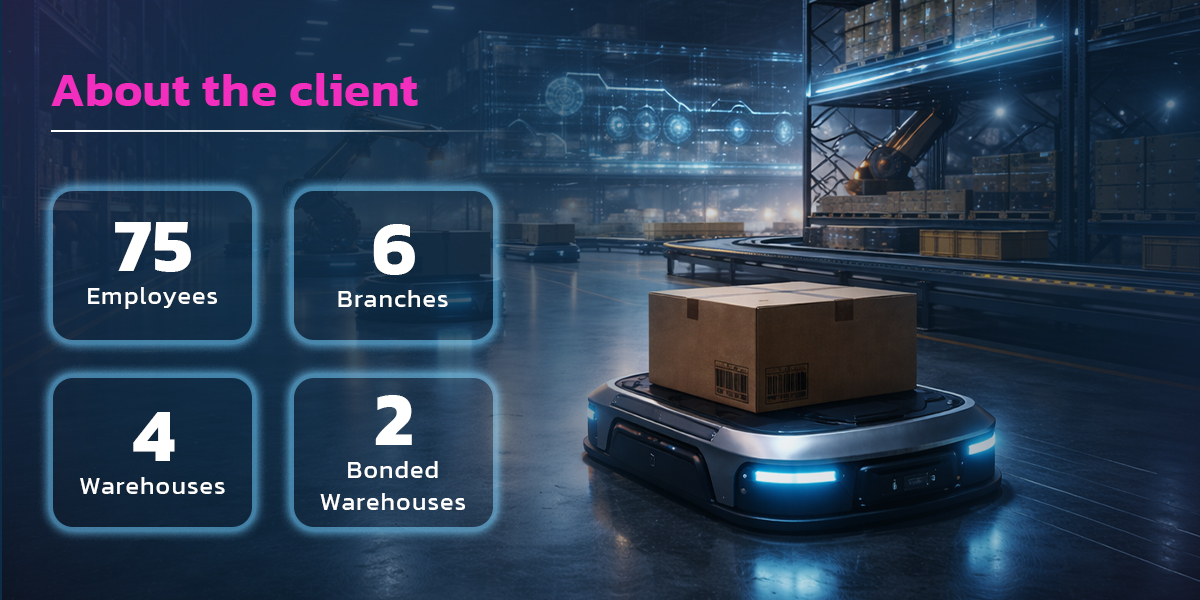
This execution maturity gap was evident in a recent engagement led by our entity, SFL Tech. The client; a multi-site regional logistics operator, had achieved strong top-line growth.
However, operational strain was increasing across its warehouse network.
- Inventory management was paper-based.
- Master data integrity was inconsistent.
- Warehouse zoning lacked structure.
- Billing required manual reconciliation.
- Client visibility was limited.
The instinct was to deploy a Warehouse Management System. The diagnosis required something deeper. Before any system implementation began, SFL Tech initiated a structural reset:
- A full operational audit across sites.
- Master data rationalisation and code cleansing.
- Warehouse layout and bin redefinition.
- End-to-end process reengineering aligned to system logic.
- Institutionalised SOPs and approval matrices.
- Phased deployment modelling to stabilise execution
Only once the operating model was stabilised was CargoWise WMS deployed as the execution backbone. Technology followed architecture.
The Result: Structural Performance, Not Incremental Efficiency
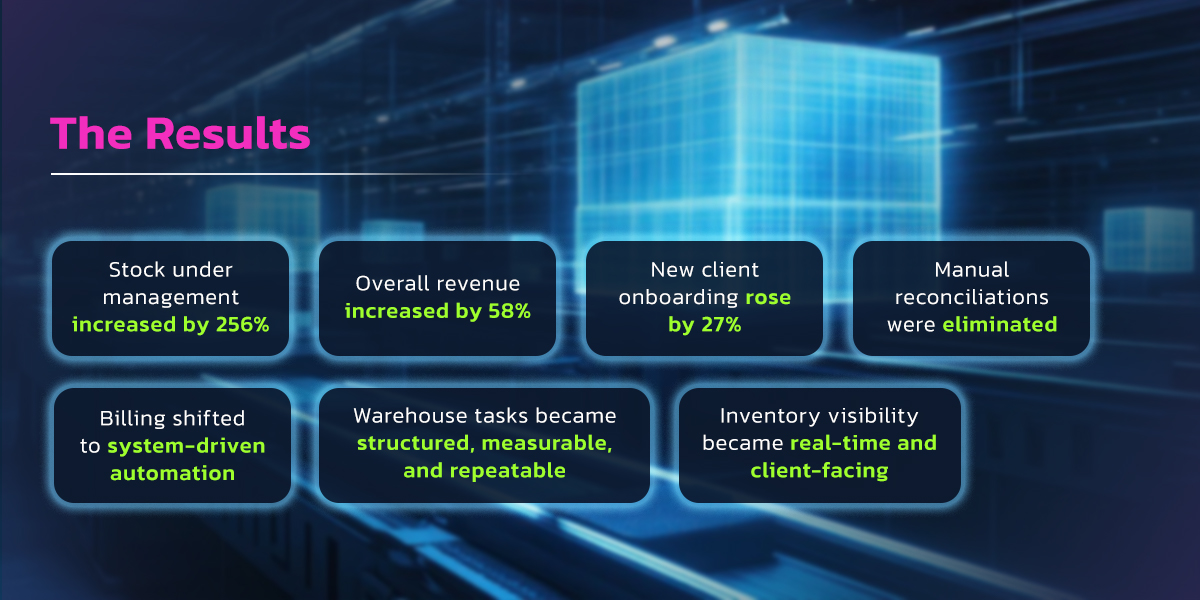
Within months of implementation:
- Stock under management increased by 256%.
- Overall revenue increased by 58%.
- New client onboarding rose by 27%.
- Manual reconciliations were eliminated.
- Billing shifted to system-driven automation.
- Warehouse tasks became structured, measurable, and repeatable.
- Inventory visibility became real-time and client-facing.
The warehouse transitioned from cost centre to revenue contributor. But the deeper result was this: The warehouse stopped operating as an isolated function and began operating as part of an integrated supply chain ecosystem — governed, visible, scalable.
In global logistics, problems are rarely linear. They are interconnected across systems, geographies, data, and people. Solving them requires more than implementation. It requires architectural alignment across the enterprise. And that is where transformation becomes durable.